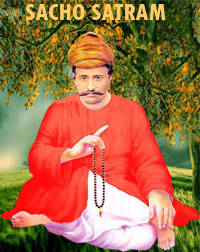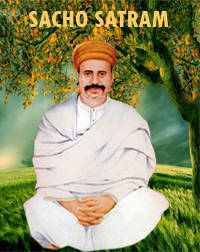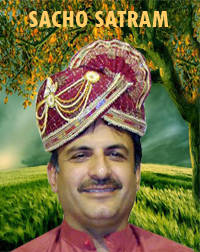
On the auspicious occasion of Deepawali, Hazir Swaroop Sai Sadhram Saheb conveyed His blessings and explained that Deepawali is a festival filled with understanding, wisdom, joy, divine grace, righteous deeds, and noble actions. He guided that every human being should learn to preserve and sustain their destiny, fortune, and divine grace forever.
Deepawali is associated with Maa Laxmi and Bhagwan Shri Ram.
Maa Laxmi’s divine connection dates back to Satya Yug, and Bhagwan Shri Ram’s to Treta Yug.
On Deepawali, we worship Maa Laxmi and light lamps to celebrate the homecoming of Bhagwan Shri Ram.
In His enlightening Deepawali message, Hazir Swaroop Sai Sadhram Saheb explained that during the Samudra Manthan (churning of the ocean), when Maa Laxmi manifested, She chose to reside at the feet of Bhagwan Vishnu. Maa Laxmi, being the Goddess of wealth and fortune, wished to distribute these blessings among all Her children.
Therefore, She entrusted Kuber with the responsibility of safeguarding and multiplying all wealth and entrusted Bhagwan Shri Ganesha with the responsibility of distributing it among the wise.
The principle behind this divine arrangement was that those who use their wealth wisely and righteously will truly benefit from it, whereas those who misuse or waste it will not receive its blessings.
During Deepawali, Bhagwan Vishnu remains absorbed in Yogic repose, accompanied by Kuber, while Maa Laxmi is always seen with Her son, Lord Ganesha. Hence, we worship Lord Ganesha along with Maa Laxmi on this sacred day, for wherever Maa Laxmi visits, Lord Ganesha accompanies Her to ensure that wealth is distributed rightly.
Lord Ganesha divides wealth according to two divine principles “Shubh” (Auspiciousness) and “Laabh” (Benefit or Profit).
This means that whoever uses their wealth for righteous and noble purposes attains its fruitful benefits, but those who do not make good use of their wealth do not truly benefit from it.
Thus, “Shubh”, auspicious action, lies in our own hands.
How we use our blessings and wealth determines what kind of “Laabh” (gain) we will receive, which is granted to us by Lord Ganesha according to our deeds.
Saijan explained that we must be particularly cautious when our destiny and fortune are favorable. We must not misuse our good times. True benefit, or “Laabh,” comes only when we preserve our blessings through gratitude, righteous deeds, and awareness.
The fortune, grace, and blessings bestowed upon us by God must be protected and valued. The more we safeguard them, the more God continues to bless us.
Saijan illustrated this with an example —
If we give someone a gift and they receive it lovingly, keep it carefully, or use it wisely, we feel happy and wish to gift them again. But if they throw it away, neglect it, or misuse it, we feel disheartened and would hesitate to give them another gift.
Similarly, when we make good and responsible use of the blessings granted by God, our good fortune, opportunities, and grace, He continues to bless us more and more abundantly. But if we neglect or misuse them, those blessings diminish.
Hazir Swaroop Sai Sadhram Saheb explained that Deepawali is a festival of good fortune and prosperity. We worship Maa Laxmi on this day to strengthen our fortune through wise and positive use of the blessings we already have. This helps us progress and prosper in life.
Maa Laxmi represents the eight forms of wealth, Ashta Laxmi — including good fortune, destiny, prosperity, property, dignity, grandeur, abundance, divine grace, meditation, love, the power to overcome shortcomings, and self-improvement.
Whatever good we possess, our fortune, talents, influence, wealth, and honor, should be shared with others. Our happiness must be spread so that joy multiplies and goodness expands in every direction.
Maa Laxmi’s open hand in Her idol symbolizes this continuous giving. Thus, Deepawali is not only a day to receive gifts but also a day to share and give.
Our life is not meant to be lived only for ourselves, but in harmony with others.
The gifts of life given by God are not to be hoarded, but to be shared generously. Maa Laxmi, by giving Lord Ganesha and Kuber the responsibility of distributing wealth and prosperity, conveyed that divine gifts increase only when shared and diminish when confined to oneself.
Hazir Swaroop Sai Sadhram Saheb also reminded us that on this day Bhagwan Shri Ram returned to Ayodhya.
From His life, we learn the importance of love, equality, and forgiveness.
Bhagwan Ram never treated anyone as an enemy; He gave Ravan repeated chances to correct his mistakes. When Meghnath’s wife, Sulochana, sought her husband’s head from Bhagwan Ram, at a time when He was at war with Ravan. Ravan himself permitted her to go fearlessly, knowing that Bhagwan Ram, the embodiment of righteousness, would never harm her.
Though Ravan had abducted Sita Mata, even he knew that Bhagwan Ram would always uphold His dharma. Bhagwan Ram fought only when Ravan’s actions left no other choice.
When preparations for His coronation were underway and joy filled Ayodhya, Kaikeyi, under the influence of deception, demanded His exile. Thus, happiness turned into sorrow.
In ancient times, every palace had both a temple and a “Kop Bhavan” (Chamber of Anger).
Those filled with peace and joy stayed in the temple, while those consumed by anger would go to the Kop Bhavan, to cool down and reflect so that their emotions wouldn’t disturb the harmony of the household.
Today, we lack such spaces and perhaps expect everyone to control themselves in all circumstances.
Hazir Swaroop Sai Sadhram Saheb explained that when Kaikeyi, who once deeply loved Ram, turned against Him under misleading influence, the entire atmosphere of the palace changed, and joy left the home.
The one destined to become king had to spend fourteen years in exile, and to bring Him back, all of Ayodhya endured immense pain and longing.
When Ram returned, lamps were lit, sweets were shared, and Ayodhya once again bloomed with happiness and divine fragrance — this is why we celebrate Deepawali.
Saijan beautifully explained that whenever negativity, anger, or discord enter our homes, societies, or congregations, God departs from that space.
As long as God dwells within, there is joy, prosperity, and abundance; but once He departs, only sorrow, regret, fear, and restlessness remain.
Hazir Swaroop Sai Sadhram Saheb narrated that when Shahanshah Satguru Sant Sai Satramdas Saheb was preparing to leave His mortal body, Sant Sai Kanwarram Saheb asked, “How shall I live without You?”
Shahanshah Satguru replied with deep wisdom —
“There is only one difference between a shirt and a shroud (kafan): a shirt has a pocket, while a shroud does not. The pocket lies close to the heart, if it is filled with jealousy, deceit, anger, or hatred, then God can never dwell there.
But if that pocket, that heart, is filled with love, truth, goodness, and purity, then God Himself will come and reside in it forever, never leaving you.”
He said,
“Therefore, keep your heart pure and true, and I shall never be separated from you.”
Saijan explained that wherever there is love, devotion, and sincerity, there God resides.
That is why, when our destiny and fortune are favorable, we must protect them with love, truth, and righteous deeds.
When our intentions and actions are pure, Laabh, divine benefit, will always remain with us.
This is the very message that Lord Ganesha symbolizes and blesses us with.
Like Lord Ganesha, we must use our fortune, prosperity, knowledge, love, integrity, and wisdom wisely; and like Kuber, we must safeguard and preserve them with discipline, for that is how true benefit is attained.
The auspicious day of Deepawali is a day to receive and share divine grace.
If you have a talent, a good habit, noble action, or spiritual knowledge, share it with others.
Whatever is shared with love always multiplies.
To live happily oneself and to bring happiness to others — this is the true message of Laxmi Pujan.
When we preserve our fortune and destiny through good actions and righteous living,
we continue to receive joy, grace, and divine blessings;
our steps move in the right direction,
and we progress towards the light of God’s compassion.
Hazir Swaroop Sai Sadhram Saheb concluded His message, saying —
“Today is the day to understand and protect our fortune, destiny, and the principles of Shubh and Laabh.
That is why we worship Lord Ganesha along with Maa Laxmi.
This auspicious festival of Deepawali reminds us that,
‘Where there is love and devotion, there too dwells God.’”
Sacho Satram