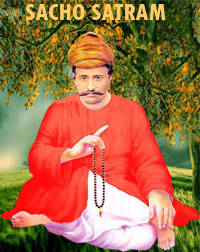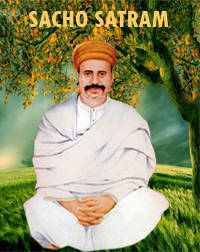
In His enlightening and inspirational Satsang delivered at the 30th International Sindhi Sammelan in Manila, Hazir Swaroop Sai Sadhram Saheb shared profound insights about the significance of this unique gathering. He said that the Sammelan holds a special place in the hearts of Sindhis across the world because it fulfills one of its foremost purposes, bringing Sindhis from all corners of the globe together to exchange views, share ideas, and strengthen the flame of preserving Sindhi civilization, culture, and traditions.
Saijan beautifully explained that although Sindhis were scattered across the world after the Partition, they carried with them dignity, self-respect, and a strong will to rebuild their lives. They worked tirelessly, often in foreign lands and unfamiliar circumstances, to earn their livelihood and establish themselves with honor. Despite the distance and dispersion, no force has ever succeeded in breaking the unity of the Sindhi community.
He emphasized that connection among community members — through meetings, gatherings, or any communication platform, is vital. The more connected a community is, the stronger and more progressive it becomes. Disconnection, on the other hand, weakens and destabilizes it.
Hazir Swaroop Sai Sadhram Saheb explained that the present Sindhi generation is not the first but the third or fourth generation living across the world. Every generation transforms in about 20 to 25 years. It has been nearly 78 years since the Partition, and today, the great-grandchildren of the early Sindhi settlers are spread across various countries. He cautioned that if we do not remain connected, the original identity and roots of Sindhis may gradually fade away, and future generations may lose touch with their ancestral heritage.
Saijan lovingly reminded everyone that life’s real meaning goes beyond worldly pleasures. At this stage, when people are enjoying good food, parties, and luxuries, they should not mistake this for real living. True life begins when one awakens spiritually and understands the deeper purpose of existence.
To illustrate this, He gave the example of a man who once had nothing, no job, no food, and whose family was suffering in poverty. When that man suddenly received an abundance of food, he ate uncontrollably, out of greed and fear of loss. Similarly, when Sindhis lost everything during Partition and later regained comfort and prosperity, they began to indulge in material pleasures, forgetting the struggles and sacrifices of their elders.
Saijan explained that our forefathers valued wealth because they had earned it through immense hardship. They cultivated habits of saving, moderation, and simplicity, always remembering that good times can change. They lived prudently, spending only on necessities, eating mindfully, and saving for uncertain times.
He observed that the present generation, having not witnessed those hardships, spends more on comforts and luxuries, often prioritizing social status over values. Today’s children, unfamiliar with adversity, sometimes fail to appreciate the worth of their inherited wealth and feel burdened by responsibilities toward their family’s assets. They prefer a life of personal freedom and ease.
Saijan acknowledged that the Sindhi community today is flourishing, financially secure, spiritually aware, socially active, and physically strong. Compared to the past, Sindhis now possess abundance in every sphere of life and are in a position to help others.
However, He noted a difference between the earlier and present forms of abundance. Our elders used their resources for public good, establishing schools, colleges, hospitals, trusts, temples, community halls, and social institutions that benefitted countless people. Despite their charity, they still retained prosperity.
In contrast, today’s generation often builds for private comfort rather than public welfare.
Hazir Swaroop Sai Sadhram Saheb emphasized that it is time for Sindhis to revive the spirit of service and community welfare, to build institutions, undertake meaningful projects, and contribute selflessly toward the betterment of society.
He lovingly urged that every meeting or Sammelan should not merely be for entertainment but must include a purposeful agenda for the welfare and unity of the Sindhi community. Every participant should contribute an idea or initiative to strengthen the community and keep alive the flame of Sindhiyat. A meeting without purpose, He said, is not worth organizing.
He encouraged everyone to introspect and be able to answer one question:
“What did we do for our community when we met?”
Saijan shared that He had visited many countries such as Dubai, Egypt, and Sri Lanka, where Sindhis have been settled for generations. He said that the Sindhi civilization has always stood as an inspiring example of progress, hard work, open-mindedness, and tolerance. Sindh has always welcomed outsiders with love, and those who came to Sindh were so deeply respected and accepted that they, too, became like Sindhis, living and feeling as one with the community.
Sindhis, He said, possess the rare quality of adapting gracefully to any land or culture while preserving their essence. Wherever they go, they merge with the local environment, yet continue to radiate their Sindhi values and traditions.
Saijan explained a beautiful law of nature, when a person leaves his native land to earn a livelihood elsewhere, the blessings of his roots and ancestors travel with him. These blessings ensure his progress and success. Therefore, while prospering abroad, Sindhis must always stay connected with one another and contribute to the welfare of their community.
He also guided that instead of competing within the community, we must encourage and support one another’s growth. When we try to obstruct someone’s progress, we unknowingly hinder our own. Ego wastes our inner energy and clouds our intellect.
Ego, He said, is a sign of inner emptiness and depression. Those who are egoistic cannot think positively and ultimately fail in life.
Hence, the way forward is simple: Progress yourself — and let others progress too.
Hazir Swaroop Sai Sadhram Saheb further drew attention to the fact that many other communities, such as Punjabis, Marwaris, and Gujaratis, continue to uphold their traditions because they deeply respect their elders and maintain strong family bonds. Their children naturally imbibe these values. Sadly, many Sindhis today have grown distant from their elders, treating relationships as transactional rather than emotional.
This lack of respect and connection, Saijan said, is one of the reasons the Sindhi community is gradually losing its true identity.
He therefore urged that every Sindhi Sammelan or community meeting must include an agenda dedicated to Sindhi culture and traditions, to help strengthen the roots of Sindhiyat. Elders should be invited to share their life experiences, wisdom, and suggestions.
When our elders leave this world, their departure marks the end of an era. By listening to them while they are with us, we preserve their knowledge for future generations.
Hazir Swaroop Sai Sadhram Saheb beautifully highlighted that every Sindhi gathering should include at least one session where everyone expresses their Sindhiyat, by speaking in Sindhi, dressing in traditional attire, relishing authentic Sindhi cuisine, or engaging in discussions about Sindhi values, heritage, and progress.
He also advised that children raised under the guidance of elders grow wiser, more disciplined, and more successful. Therefore, Sindhi gatherings across the world should include programs based on harmony (ham-āhangi) that promote unity among organizers and guests while celebrating Sindhi traditions with pride and grace.
Finally, Saijan concluded His Satsang by showering blessings upon all who attended the Sammelan and extended heartfelt congratulations to the organizers for their sincere efforts in making the event meaningful and successful.
Sacho Satram