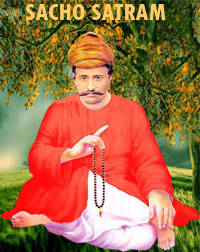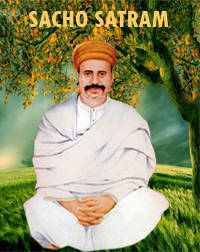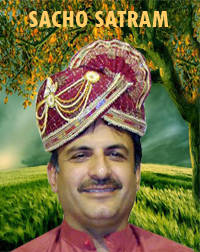
In one of His most invaluable satsangs, Hazir Swaroop Sai Sadhram Saheb lovingly explained that we must always use our intellect and wisdom in the right way.
We should understand our understanding and use it wisely. By speaking excessively and unnecessarily, we begin to lose our wisdom and awareness. We lose our personality, our dignity, and our respect. To preserve our identity, our respect, and our wisdom, we must speak less, and only speak where it is necessary, and only as much as is required.Hazir Swaroop Sai Sadhram Saheb shared that when He was young, He would hear elders say that wise people would advise those who talk too much to speak less, otherwise they would “drain away their intellect.”
When a person speaks excessively and without thought, their wisdom begins to flow away. That is why we sit in solitude. In solitude, we learn how to speak less and speak rightly. In that stillness, we connect with our Supreme Father—and that connection happens only when we make ourselves worthy of meeting Him. This preparation comes through self-improvement and inner refinement.
By speaking less and using our understanding correctly, we can make ourselves worthy of uniting with the Divine.
The more we remain mindful of what is right, such as speaking less, and the more we distance ourselves from what is wrong—such as excessive talking—the better we become.
No matter how abundant good practices are, we should always embrace them. Yet, we are often so surrounded by wrong habits that even when goodness increases, we begin to question it.
For example, when a festival is celebrated over two days, we tend to focus on which day is the “correct” one, and we start arguing about it. We fail to reflect that if a good occasion can be celebrated for two days, or even four days, it is a matter of joy. If a fast extends beyond one day, what is wrong in that? If Janmashtami is observed over two days, why not celebrate it wholeheartedly? Instead of engaging in disputes over the exact date, why not value the opportunity to celebrate goodness more?
In life, whatever good opportunities we receive, we should embrace them fully. The more we adopt goodness, the more beautiful our life becomes.
Saijan shared a story of Baba Hardasram Ji. One day, a man came to Baba Ji and asked, “When is the full moon?”
Baba Ji replied, “The moon is present every day.”
The man said, “But Baba, the full moon does not appear every day.”
Baba Ji explained, “For a person whose intentions are pure, the moon shines in their life every day.”
He further said that the more we choose to see goodness, the more successful and fulfilled our life becomes. Goodness should not be confined to a few days, it should be lived every day, in every action, and through every occasion.
Saijan explained that our Deities, Bhagwan Ram, Bhagwan Krishna, and all Saints and Mahatmas have always lived in goodness, every single day. If we observe their entire lives, we understand that each moment of their life was filled with virtue. Yet we often pick only one teaching from their lives, while their entire existence was a reflection of goodness.
Then why should we limit our goodness to just a few days? Why can we not remain good and joyful always?
If we are given the opportunity to do something good for one day, and we can extend it to two days, why not do so? Why does it feel difficult for us to fast for an extra day or celebrate a festival more deeply? Why do we lose the opportunity that comes to us by getting caught in debates over dates and technicalities?
Hazir Swaroop Sai Sadhram Saheb lovingly guided that there should never be arguments over anything good. May the Divine bless us that not just for one or two days, but always, we remain good and continue to celebrate goodness.
Why should the birth of Bhagwan Krishna be celebrated only on Janmashtami? His birth should be celebrated every day. It is not just about observing one day of His birth, His entire life was divine and exemplary. We should celebrate His life every single day, rather than debating which date is correct.
Good messages and sacred festivals are not meant for just one day, they are meant for our entire life. Bhagwan took birth on one day, but His whole life was elevated and divine. In the same way, we should learn from His life and strive to make our entire life noble and worth celebrating.