True transformation begins within. We must first nurture and uplift our own self before attempting to uplift and transform others.
In life, just as in an aircraft where we are instructed to secure our own oxygen mask before assisting others, it is essential that we first take care of ourselves. Strengthening our mental and physical health through conscious awareness is not a selfish act but a necessary foundation. When we are emotionally balanced, mentally alert, and physically well, we become truly capable of extending support to others. Only a stable and nourished self can uplift, guide, and help others to grow and progress.
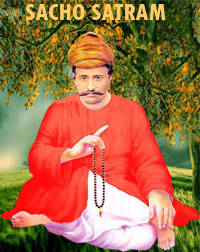
In one of His divine Satsangs, Hazir Swaroop Sai Sadhram Saheb lovingly emphasised the importance of first focusing on our own spiritual growth. Only when we uplift ourselves can we truly help and uplift others.
We too wish to change ourselves, to bring transformation into our lives. When change comes into our life, we become the right kind of human beings, we discover the right purpose, and we reach the right destination.
If there is no transformation in life, we will continue to swing between moments of joy and sorrow, and our life will remain unsteady. The very purpose of coming into the refuge of the Satguru is to transform ourselves—and we must have a deep inner understanding of this. If we wish to change but lack true awareness of what that change requires, then no matter how much we do, we will never attain as much as we truly seek.
When we do not change ourselves and remain entangled in the ups and downs of life, we begin to wonder what we have truly gained in life. Despite all our seva (selfless service), prayers, and worship, life still feels full of turbulence, and happiness does not remain constant. Life continues to waver; we are unable to stay truly happy even in moments of joy, and we struggle to endure sorrow.
The truth is, the real purpose of coming to the Temple is to bring about a transformation within ourselves.
And only when we understand this do we come to realize the truth. When we do not understand this truth, we are unable to truly attain anything, even after doing everything. We all know that we should treat others well, help them, and bring happiness to their lives. We all engage in good deeds, charity, and acts of service.
But despite doing all this, are we truly content deep within?
Even after doing so many good things, we often find ourselves not truly happy.
Despite all the good we do for others, we often remain unhappy—because we skip the step that must come before helping others.
Before practicing paropkar (selfless service to others), one must first engage in sva-upkar (self-upliftment).
Helping others without first helping oneself is like trying to enter fifth or sixth grade without passing the first and second.
To climb a staircase, we must begin from the bottom; we cannot skip the lower steps and reach the top directly.
In the same way, before we serve others, we must serve and strengthen ourselves first.
Sva-upkar means to nurture, strengthen, and care for oneself—both physically and mentally.
Can we skip first and second grade and directly reach graduation level? No, we cannot—because nothing will make sense to us.
Hazir Swaroop Sai Sadhram Saheb narrated a story to rxplain this in detail, he told that
An illiterate man once walked into an optical shop and said he wanted a pair of spectacles. The shopkeeper made him try several different glasses to determine his number, but no matter how many pairs the man tried on, he kept saying he still couldn’t understand the letters in front of him.
The shopkeeper was baffled. After several attempts, he finally asked the man why even such strong glasses weren’t helping him see clearly.
The man replied, “That’s exactly why I came here—because I can’t read.”
Saian explained: If someone doesn’t know how to read, no matter how powerful the glasses are, they still won’t be able to read.
To read, one must first learn how to read. Before extending light to others, we must first kindle our own flame.
Self-care is not selfishness, but sacred preparation for true service. The purpose of coming into the refuge of the our Satguru is to transform and uplift oneself.
Unless we improve ourselves and become better human beings, how can we truly work for the betterment of others?
No matter how educated or wealthy we may be, our actions will always reflect the nature of our thoughts.
To do good to oneself means to transform oneself.
We must look within and honestly reflect:
After coming into the refuge of the Satguru, how much have we truly changed?
How much purer have our thoughts become, and how far have we moved away from negativity and wrongdoings?
Good thoughts lead to good actions, while negative thoughts compel us toward harmful deeds.
Hazir Swaroop Sai Sadhram Saheb explained that just as we can spend only when we have earned something, in the same way, we must first earn or cultivate goodness within ourselves before we can extend it to others.
Only when we become good ourselves can we truly do good for others.
Sai Jan said that when we walk the right path, live with truthfulness and honesty, and engage in sva-upkar (self-upliftment), we naturally and effortlessly become capable of paropkar (selfless service) .
When we become self-reliant, we are no longer affected by what others do. We walk our path with complete self-confidence, illuminated by the light of our inner mind. We neither get misled by anyone nor do we wander aimlessly.
Hazir Swaroop Sai Sadhram Saheb explained to us that living in the world and performing our duties is not wrong, but it is important to ensure that our actions are righteous. If we are earning well through our work or business, that is fine. But we must understand whether we are using that earning wisely or misusing it.
It is important to reflect:
Is our income leading us toward sin or guiding us on the path of truth?
Are we becoming egoistic, or are we walking with humility?
This understanding is essential. The way we use any earning can either build us or break us, it can either uplift us or lead to our downfall.
True goodness is not just about helping others in public or doing acts of charity when people are watching.
The real test of a person’s character is how they think and behave when no one is around—when they are alone.
Hazir Swaroop Sai Sadhram Saheb explained that many demons performed intense penance and austerities to obtain boons. However, after receiving those boons, they misused their powers by engaging in wrongful and sinful acts, which ultimately led to their destruction. This was because even during their deep penance, their intentions were impure.
If the intention behind any action is impure or selfish, then no matter how much power one gains, it eventually gets destroyed.
Ravan was a great ascetic, a learned scholar, a generous giver, and a powerful man of wisdom. He had performed countless good deeds, but one grave sin of his destroyed all his accumulated virtues.
There were also others who, with a pure heart, performed intense penance with the desire to bring happiness not only to themselves but to the entire world. When they received divine powers as a result, they used them wisely for the welfare of all. Such noble beings went beyond even the heavens and attained oneness with Parmatma in Vaikunthh (the divine eternal abode).
Hazir Swaroop Sai Sadhram Saheb explained that we often say Shahanshah Satguru was compassionate and selfless. Even towards the one who killed his own child, he held no hatred. Instead, he advised everyone not to harbor hatred either, saying that what had to happen had already happened.
Similarly, we say that Sant Sai Kanwarram Saheb was a great benefactor. One day, when someone—out of anger struck his face with a pouch filled with coins, Sant Sai Kanwarram Saheb lovingly spoke to that person and gently helped him understand his mistake.
Saints and Mahatmas treated even wrongdoers kindly, not just because they were compassionate toward others, but because they were svaupkari (self-uplifted) . They had elevated themselves to the heights of goodness and truth.
Those who become truly good within themselves naturally become benefactors of others. They don’t have to make a separate effort to help others—their very being radiates compassion.
SaiJan explained that every single action, every single step, and even every breath of a svaupkari (self-uplifted) soul becomes a source of benefit for others. Such a being’s spiritual strength is so powerful that those who come near them begin to absorb that energy and gradually transform themselves.