
How to Meditate Click here to watch the video
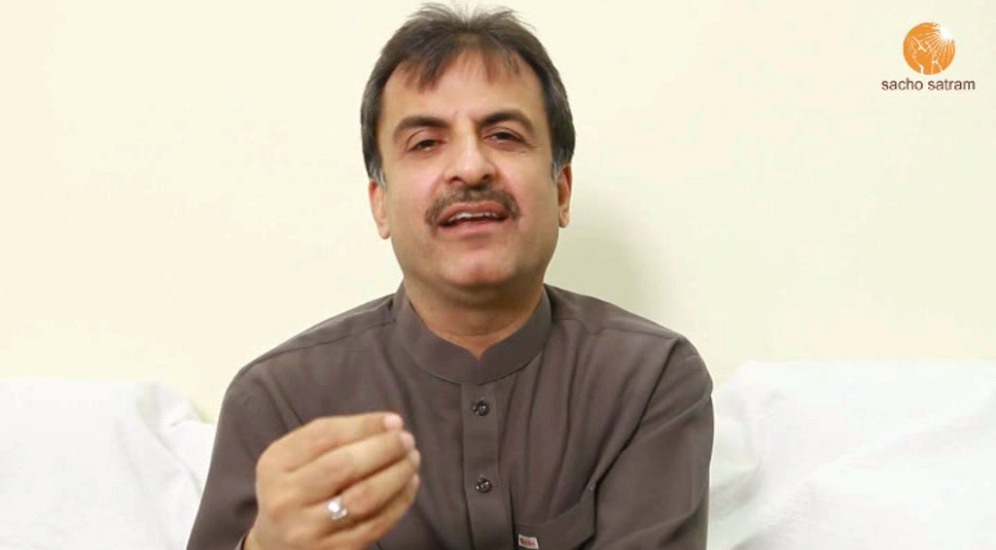
Sacho Satram !
Verbatim Transcript of Hazir Swaroop Sai Sadhram Saheb’s Satsang on How to Meditate
Now the question will arise: How should we meditate?
Meditation!!!
But before we ask how to meditate, we must first reflect: Why are we meditating?
The meaning of “why” is: For what purpose are we doing it?
Because when we sit in meditation, many thoughts and reflections come to us.
Sometimes we meditate to improve our thoughts, sometimes to attain God, sometimes to refine ourselves, and sometimes even for our health.
So—how should we do it?
First of all, whichever posture is convenient for us, whichever position is suitable, we can sit in that way. At times, we may sit in one asana, at times in another, according to what is needed.
But when we are coming into meditation, we are coming towards that Lord, that Supreme Being. So, for that, we should sit in a simple, comfortable way, wearing light clothes, with hands gently joined, both legs together, and eyes closed in meditation.
And as soon as we close our eyes, naturally, our attention will come to the Ajna Chakra, the point between the eyebrows. We do not need to force it, it happens by itself. The Ajna Chakra is the center of our thoughts, ideas, and understanding. It is the seat of our intellect and wisdom, the center of our power of thought.
Let me give you an example.
When we are writing something and suddenly forget a word, a number, or a name, our pen stops, and we begin to put pressure on our mind. As soon as we do that, the other end of the pen automatically begins to tap our forehead, always at the point between the eyebrows, never on the cheek or shoulder. This shows that we are awakening this center, the Ajna Chakra, to bring back our memory.
Or when we do something praiseworthy, or even something that may cause hurt to others, we instinctively touch our forehead, thinking, “I have done something big—I can do anything.”
And when we cannot do even a small task, we strike our forehead in frustration, saying, “Why did my mind not work earlier?”
The truth is, the Ajna Chakra is the place of our thoughts, understanding, intellect, and wisdom. That is why meditation is placed here, so that the grace and mercy of the Lord may descend here, making our thinking and understanding correct.
If our thoughts and understanding are correct, then wherever we are, at any time, no wrong thought will come, and no wrong deed will follow. We will always move forward with truthful actions. But if this place is not right, if our thinking and understanding are not right, then wherever we may be, whatever environment we are in, our steps will turn towards the wrong direction.
That is why meditation is placed at the Ajna Chakra, to purify our thoughts, understanding, intellect, and wisdom. This is also why it is called the Shiva Netra, the Eye of Shiva.
The meaning of Shiva is auspiciousness, well-being, joy, bliss. If this Ajna Chakra becomes pure and clear, our entire life becomes blessed, our thoughts become good, our intellect works rightly, and every action becomes blissful. Life itself becomes pure.
That is why meditation is placed between the eyebrows, praying:
“O Lord, grant me Your grace here, so that my thoughts and understanding may be right.”
When thoughts and understanding are right, everything else becomes right. After meditation comes Simran, our remembrance, our mantra, our chanting.
In the Naam Mantra lies immense power. In even a single syllable, infinite blessings and grace are contained, enough to purify and illuminate our entire being, making us pure in this world and worthy of reaching the Lord.
This Naam is to be taken with every breath, in every inhalation and exhalation. When we meditate, and then engage in Simran, we must do it in the way taught by our Satguru. As we synchronize Simran with our breath, we begin to notice that the rhythm of our breath itself becomes right.
Observe—our breath reflects our own self.
In public, at home, in office, in society, we behave properly, dressed well, speaking politely. But when alone in our room, we may sit or lie in any careless way. Yet the moment someone enters, we adjust ourselves immediately. Similarly, our breath also needs attention, when we observe it, it naturally becomes disciplined.
In meditation, pranayama, Naam, or Simran, correct breathing is essential. Proper breathing gives oxygen to the brain, keeps it functioning rightly, clears clots in the blood, and ensures smooth circulation. When circulation is proper, the heart works well, kidneys purify correctly, the liver remains healthy, and almost 70% of illnesses are prevented.
Thus, breath gives us health and life. When it is combined with Naam, it becomes so powerful that it awakens all inner energies, opens the Kundalini, purifies us completely, and leads us to the Lord.
Therefore, in life we must hold firm faith to reach our goal.
Meditation is our goal, and Simran is our steadfast faith.
As long as we do not attain that Supreme Lord, no one can shake us from this path—we will continue to move forward.
Now, where should we sit for meditation? How should we sit?
We can sit anywhere, in any posture, but we must surely sit.
If we face the East, the rays and energy we receive bring immense peace and upliftment. But most important is that we sit—calmly and peacefully.
Before beginning, we should join our hands and fingers together, close our eyes, and sit silently for a few moments—not thinking, not speaking, just in stillness.
Gradually, as the mind becomes calm, begin to observe the breath and gently bring in Simran with each inhalation and exhalation.
If disturbing thoughts come, do not fight with them. Instead, lovingly pray:
“O Lord, give me so much grace, strength, and wisdom that when I sit in Your presence, only You remain. May all other thoughts fade away.”
And to the thoughts, say gently:
“For 23 hours of the day I am with you. Just allow me this half hour for my Lord, my Satguru. I will return to you afterward. If you wish, you may also join me. But for this short while, please step aside.”
When we say this with love, not with struggle, the thoughts themselves quiet down.
In this way, our meditation deepens. At the end, we should always thank the Lord, saying:
“O Lord, it is Your grace that You made me sit in meditation, that You gave me the chance to hold myself steady. Bless me further so that I may remain worthy of Your grace.”