
What is Dhyan (Part 1) Click here to watch the video
Sacho Satram!
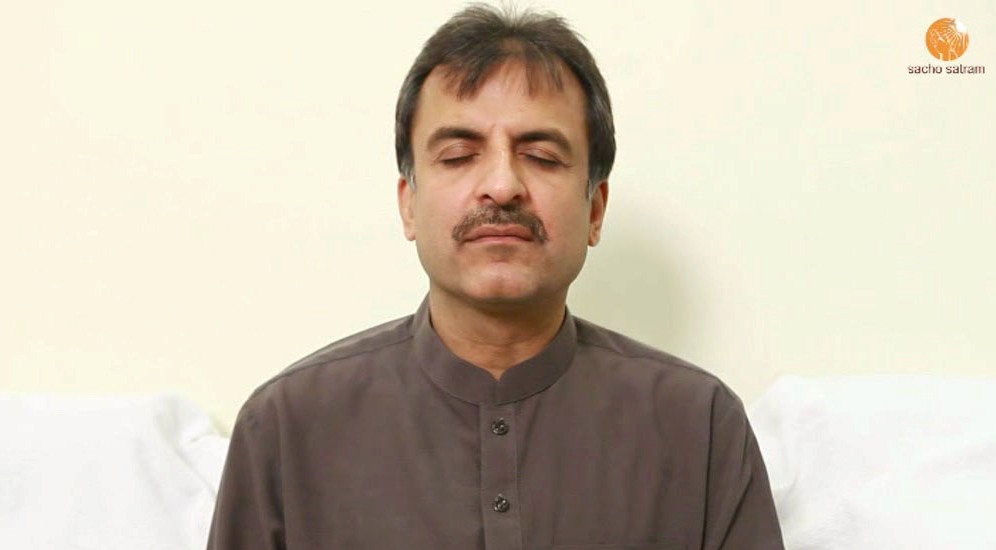
Dhyan (meditation)
Verbatim Transcript of Hazir Swaroop Sai Sadhram Saheb’s Satsang on Dhyan (Meditation)
No matter how much we explain or say about meditation, before even saying it, it takes us so high that while doing all worldly duties, we reach up to the Supreme Being.
That is why first of all, we must see what is meditation?
In reality, meditation is the process of seeing ourselves, of examining ourselves, and of testing ourselves, because all of us human beings in this world, each one considers himself to be right.
We believe, I am the one doing right, the other is doing wrong. I am walking on the right path but no one tolerates me. I think good of others, but no one thinks good for me. Every good thing, I try to bring to myself, and every wrong thing, I try to put on others.
But when we sit in meditation, then we come to know what are we really?
Because as soon as we sit in meditation, so many thoughts, so many ideas begin to come good, noble, bad, negative. So many thoughts come, and sometimes, mostly, thoughts come which have no relation to us at all. We do not even know if it ever happened, or will happen, and sometimes we think it will never happen—yet still such thoughts keep troubling us.
And sometimes such lofty thoughts come that we begin to think how will I ever be able to do this? Or not? But still, those thoughts keep coming.
So in reality, we keep thinking others are wrong and we ourselves are right, but when we sit in meditation, we come to know what is our own thinking? What are our own thoughts?
If our thoughts, our ideas for someone, towards someone, are good, then this is positive, this is good, this is better.
If by mistake we are thinking wrongly about someone, keeping wrong thoughts about them, then we must not even mistakenly think that we are good. Because in reality, we are exactly as our thoughts are, exactly as our ideas are. Because we want to do only what our thoughts are.
But sometimes, because of someone, because of some fear, because of some culture, because of some punishment, or sometimes because of society or community, we cannot do it—that is another matter. But in reality, we want to do exactly what our thoughts are. That is why we get results only according to what our thoughts are.
That is why, first of all, meditation shows us what we really are.
Then, as soon as we come to know that my own thoughts are not good, then how can I think anything for others? Then we will come to know—what really am I?, I will give you one example.
Suppose you go to a temple. In the temple, you do prayer or Ardas, and you say, Lord, bury my enemy, bury him, meaning kill him and put him into the ground. To “bury” means completely finish him. Now, just think about it someone who did a little bad behavior with us, gave us a little trouble, or we just thought he did not behave well with us whether he did or not, that decision is not ours, that is up to him. But if he did a little wrong or troubled us a little, then we thought bad for him, and we prayed that he should be buried, destroyed, completely finished.
Now think—who is more of an enemy, him or us?
He troubled us a little, but we buried him completely, finished him—that makes us greater enemies, not him.
That is why in meditation, we come to know—what are we really?
Then when we come to know that there is some shortcoming in us, some mistake in us, then slowly, slowly, we will bring ourselves towards improvement.
Then only that will happen which is good for us, which is better for us.
Then, when we rise higher in meditation, then the Saints, the Mahatmas, the Darveshs, the Fakirs, whatever they are teaching us, we will rise to that, to what they are teaching us. Then the meditation we do will take us to the next step, and we will move forward in that chain.