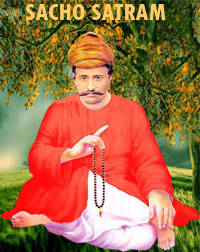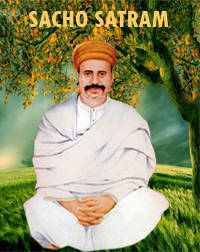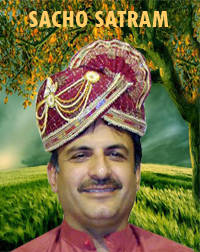
On the blessed Green Thursday, which also coincided with the sacred days of Ganesh Utsav, Hazir Swaroop Sai Sadhram Saheb lovingly explained in His satsang that whenever we celebrate the occasion of a great Saint, Mahapurush, or Deity, the real meaning of the celebration is to live like them to adopt their teachings in our own live.
For example:
A bird builds its nest so skillfully, collecting each straw one by one, that not even a single drop of water can enter it.
An animal living in a burrow or cave designs it in such a way that it remains unaffected by changing seasons.
Some creatures build homes underground so securely that nothing can enter, and they can live safely inside.
Depending on the season, animals collect and store their food in advance. They instinctively know how to protect themselves, where to find food, how to recognize threats, and how to live with awareness of their joys and sorrows.
As it is said about a lion: it never eats grass; even when close to death, it will not touch it. Yet if its stomach becomes unwell, it knows that healing will come through medicinal herbs, so it eats grass. By doing so, it vomits and purges, and its stomach becomes fine again.
Among all creatures, even the tiny mosquito is remarkable. No sensory system can match its precision. When it bites, it knows exactly where to land to draw blood. It does not bite randomly; its sensory system guides it to the right spot. We say, “A mosquito bit me,” but in reality, it is simply fulfilling the work assigned to it by nature.
No mosquito learns from another where to bite, no ant goes to a training center to learn how to cut and store food, no bird attends a school to learn nest-building, and no rat goes to a workshop to learn how to dig a burrow. They are born with these instincts.
Only we humans are different — we require schools, training centers, and colleges.
If someone asks us to build a house, most of us cannot even construct a single wall on our own.
In illness or difficulty, we depend on others.
We cannot even make decisions alone.
We depend on others for guidance, education, wisdom, and direction.
Even to learn how to eat food properly, we require instruction.
We humans are the only beings who need training to become “human.” All other creatures are naturally equipped to fulfill their purpose.
When we are born, we carry with us the tendencies and impressions of many past births — as animals, birds, even divine or demonic beings. According to the environment and the feelings of the time, we act accordingly. That is why we need schools, training, satsangs, guidance from saints, and motivational lectures to refine ourselves. Whatever nature dominates within us, we begin to live that way. But to progress in the right direction, we must consciously change ourselves to reach the greatness of humanity.
Saijan explained that when we meditate on the life of Shahanshah Satguru Sai Satramdas Saheb, we see how good people became even better in His company, and those who were misguided became noble. The ignorant gained wisdom through His blessings. Some transformed instantly at His darshan — like the tantric, or the quarrelsome man, or the angry young boy. That boy, when brought to Raharki Saheb at the command of Shahanshah Satguru, left all his bad habits and became wise and cultured.
Many learned the value of seva, like Bhai Ganesha. Some, like Bhai Sughuram, changed by Satguru’s guidance. Others, suffering deeply, found relief through His blessings, like the man from Madeji whose incurable fever was cured forever. Each one, in different ways, experienced transformation in His shelter.
Speaking about Lord Ganesh, Saijan explained that Ganesh Ji was formed from the divine essence of His mother’s body. Later, Lord Shiva replaced His head with a new one, meaning that all old karmas, thoughts, misunderstandings, and wrong habits were removed, and new wisdom, joy, and prosperity were bestowed upon Him.
Ganesh Ji’s large head symbolizes an expanded intellect, being broad-minded, not narrow.
His big ears teach us to listen fully, understand deeply, and only then respond wisely.
His small mouth symbolizes speaking less but speaking with sense.
His small eyes symbolize farsightedness, the wisdom to act today with tomorrow’s consequences in mind.
His trunk symbolizes strength and adaptability , it can uproot a tree or gently lift a child.
His broken tusk, held in His hand, teaches us to remove negative emotions from within and dedicate ourselves selflessly.
The story of Ganesh Ji writing the Mahabharata shows that in noble work, we must not stop. Even when His pen broke, He used His tusk to continue writing without pause. From this, we learn that in righteous deeds, obstacles must be turned into opportunities, and one must never give up.
Ganesh Ji’s axe teaches us to cut away wrong thoughts.
His staff teaches us discipline, patience, and living by principles.
His raised hand blesses us to give, not to beg.
His sitting posture, with one leg folded on the other, teaches us humility on earth and greatness in thought.
Just as a lotus rises above water, though rooted in it, we too must live in the world but rise above worldly disturbances, staying connected to the Divine through good actions.
His modak teaches that the fruit of hard work is always sweet. But even when receiving praise, we must not let it turn into pride. Ganesh Ji holds the Modak in His hand but does not eat it, showing that we should not consume the sweetness of appreciation in arrogance, but continue doing good selflessly.
His large belly does not symbolize eating; rather, it signifies the art of balancing life. It teaches us to accept whatever comes our way with calmness and stability, without being shaken by emotions or reacting impulsively.
Thus, Saijan explained that when we look at Lord Ganpati with understanding, we do not just see a form, but a living message for our own lives. Each symbol invites us to cultivate patience, discipline, humility, balance, and generosity , virtues that can transform our journey into one of true inner strength and divine joy.
Finally, Hazir Swaroop Sai Sadhram Saheb reminded us that just as great saints and deities lived with wisdom, humility, discipline, and compassion, we too must strive to walk on their path.
He gave the example of Shahanshah Satguru Sai Satramdas Saheb, who accepted both joy and sorrow equally, welcoming congratulations at birth, as well as the pain of offering sacrifices, as the will of God.
He taught that power must be used for good, not harm. Even a tantric was guided to use his energy for noble work. Bhai Sughuram, who once carried sinful thoughts, became pure after eating prasad sent by Shahanshah Satguru Sai Satramdas Saheb. Saijan’s posture, with one leg folded over the other, symbolized keeping the ego grounded and walking humbly on earth, while keeping thoughts high and noble.
In conclusion, Saijan explained:
Human behavior constantly changes , sometimes like a lion, sometimes like a jackal, sometimes like a sweet cuckoo, and sometimes like a harsh crow. At times saintly, at times sinful.
To refine and balance these changing tendencies, we humans need schools, training, satsangs, and guidance. By transforming the lower impressions of past births into humanity, we become true humans. And it is through the path of humanity that we rise to the highest level and unite with God.